Are You a Non-U.S. Person? IRS Definition for Form 5472 Eligibility
Key Takeaways
- A 'non-U.S. person' is the IRS term for a foreign person — someone who is not a U.S. citizen, resident alien, or domestic entity
- U.S. persons include U.S. citizens, green card holders, individuals passing the substantial presence test, and domestic entities
- Your physical location does not determine whether you are a U.S. person or non-U.S. person — legal status does
- Foreign owners of U.S. LLCs are non-U.S. persons who must file Form 5472 annually
- Misclassifying your status can result in missed filings and the $25,000 penalty per form
What Does 'Non-U.S. Person' Mean?
When dealing with United States tax law, you will frequently encounter the term 'non-U.S. person.' The IRS constantly asks filers to identify themselves as either a U.S. person or a non-U.S. person — particularly on forms like Form 5472.
A non-U.S. person is essentially what the IRS considers a 'foreign person.' The phrasing may sound unusual, but from the perspective of the United States government, the question is straightforward: are you a citizen, resident alien, or domestic entity (U.S. person), or are you none of those (non-U.S. person)?
Who Qualifies as a U.S. Person?
Under the Internal Revenue Code, a U.S. person includes U.S. citizens (regardless of where they live), U.S. resident aliens (green card holders or individuals who meet the substantial presence test), and domestic entities such as corporations, partnerships, and LLCs formed in a U.S. state.
If you fall into any of these categories, the IRS treats you as a U.S. person. Importantly, this status is determined by legal criteria — not by where you physically reside or where your customers are located.
Who Is a Non-U.S. Person?
A non-U.S. person — also called a foreign person — is anyone who is not a U.S. citizen, not a U.S. resident alien, and is not a domestic entity. This includes nonresident aliens (individuals) and foreign corporations, foreign partnerships, and foreign estates or trusts.
If you are a foreign national who formed a U.S. LLC, you are a non-U.S. person who owns a domestic entity. This combination is precisely what triggers the requirement to file Form 5472 annually.
Why This Classification Matters for Form 5472
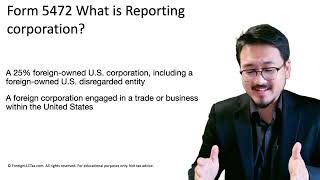
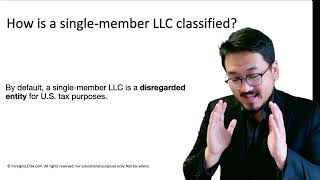
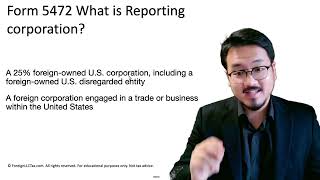
Form 5472 is specifically required when a non-U.S. person (foreign owner) has a reportable transaction with a U.S. reporting corporation or a U.S. disregarded entity. If you are classified as a non-U.S. person and you own a single-member LLC in the United States, you must file Form 5472 with a pro forma Form 1120 every year — even if your LLC had zero revenue.
Misclassifying yourself as a U.S. person when you are actually a foreign person (or vice versa) can lead to either missing a required filing or filing incorrectly, both of which carry steep penalties.
IRS Form 5472 Instructions
Official IRS source on irs.gov
Listen on Spotify
Money & Tax Talk with Rippa — 5/5 rating
Watch on YouTube
ForeignLLCTax — 187 videos
File Your LLC Taxes Now
Generate your IRS Form 5472 + pro forma Form 1120 in 15 minutes. Every field linked to official IRS instructions. $49, no CPA needed.
More on Form 5472 & Foreign-Owned LLCs
 0:57
0:57What Counts as a U.S. LLC? IRS Rules for Foreign Owners (Form 5472)
 1:17
1:17Stripe Atlas, Doola, Firstbase: Does Your LLC Count as U.S.? (Form 5472 Guide)
 0:37
0:37U.S. Bank Account Does Not Make a U.S. LLC: Foreign Company IRS Filing Rules
 1:41
1:41What Is a Reporting Corporation? IRS Form 5472 Key Concept Explained
 1:07
1:07Disregarded Entity Explained: How Single-Member LLCs Are Taxed by the IRS
 1:49
1:49